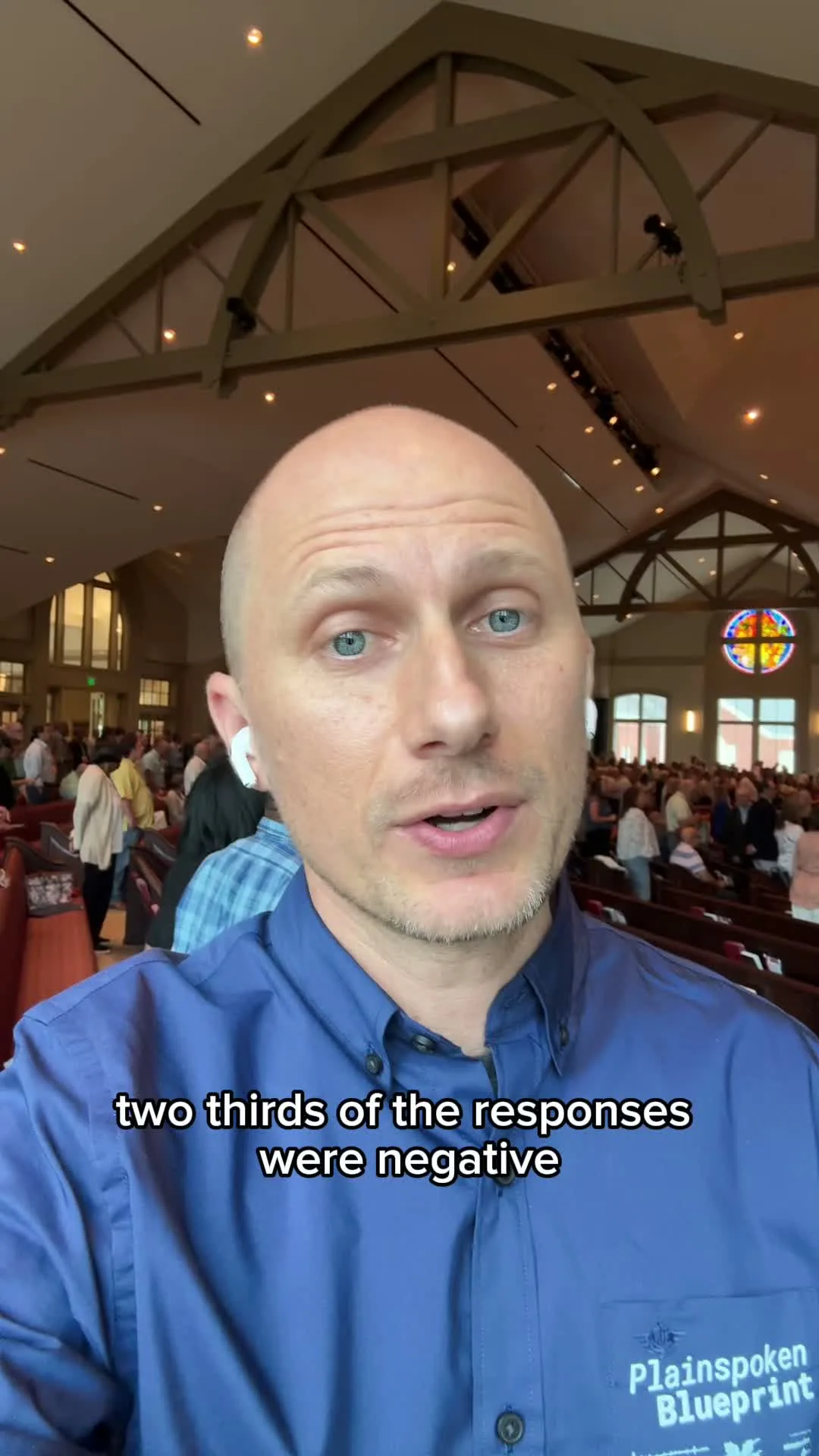
I'm a poly-vocational pastor. I've been unemployed — or underemployed — for twelve months following a mental health crisis. I built a sermon preparation tool using AI during my recovery. Two days ago, on the Sunday I returned to the pulpit for the first time in a year, I posted about it in a United Methodist clergy group.
Two thirds of the responses were negative. One third supportive.
Here's what happened — in their words and mine.
The post
I shared a link to the sermon manuscript — a piece called "A Seed Must Die" on John 12:24, developed using the Lowry Loop coaching method in SermonCoach. I mentioned it was my first time in the pulpit after twelve months away for mental health. I linked the Facebook Live video. I said I hoped it would help working preachers who are struggling with mental health or wondering how to use AI in ministry with integrity.
That was the context. Here's what came back.
The first objection: "it isn't entirely yours"
A commenter named Chase made what turned out to be the most useful challenge in the whole thread:
"It isn't 'entirely yours' if you run the content through a filter meant to make you sound like a different person in your delivery."
He added a few laughing emojis. He wasn't trying to start a fight.
My reply:
"Chase Crickenberger you would be correct, except it does not work that way. It asks you questions and you write the sermon. It refuses to write for you. SermonCoach is a Socratic coach that guides you to think more deeply."
That exchange produced the clearest two-sentence description of the product I've written. "It refuses to write for you." That's the whole thing.
Chase was arguing against a product that doesn't exist — an AI that generates your sermon and then polishes your delivery. SermonCoach does neither. It asks questions and waits. You can't move forward until you've answered honestly. The draft only unlocks after every methodology step is satisfied.
His objection is legitimate. It just doesn't apply.
The harder objection: "you're here to sell something"
A commenter named Peter Hamm came in differently:
"I feel like you're here to sell something, sir. And in case you didn't notice,... not as well-received here as you might hope.
Also, again... get back to me when there aren't ethical concerns with water, power, and essentially computerized plagiarism...
Rule #1 is 'Do No Harm.' Consumer Generative AI does harm."
He's right that there are legitimate environmental concerns with AI energy use. He's right that I'm selling something. He's right that the thread wasn't uniformly warm.
I wrote back:
"Yes, Peter Hamm, I welcome anyone to support me by paying to use my software. I'm here to share a tool I built for myself to solve a problem. Sermon coach is accessible for free. For those who want to use it more fully there is a paid version, $10/month.
I have been unemployed for 12 months. I openly welcome financial support for my family and my ministry. I am now a poly-vocational pastor, and am grateful to say, much healthier for it."
"I have been unemployed for 12 months. I openly welcome financial support for my family and my ministry."
That's a sentence I didn't plan to write publicly. It came out because I was done managing the perception. I built a tool during the hardest year of my life. My family needs income. I'm not hiding that.
The "computerized plagiarism" framing is one I've heard before. It collapses when you look at what the product actually does — it doesn't generate anything you didn't first think. Every word in the draft originates in something you said. The sermon is yours because you built it. The accusation of plagiarism requires that you believe the AI wrote it. It didn't.
Peter's "Do No Harm" argument is harder. I don't dismiss it. Consumer generative AI, used without thought, probably does harm — to clarity of thought, to originality, to the integrity of work that should come from a person. That's exactly why I built the tool the way I did. The harm I'm trying to prevent is the same harm he's worried about.
The sharpest objection: "handing over my thinking"
A commenter named Corey Simon named the deepest concern in the thread:
"If we want statistics then why not mention that on average the more people know about how ai works the less prone they are to use it.
I prefer not to hand over my thinking to an easily manipulated algorithm controlled by the most morally bankrupt goons on the planet.
I especially prefer not to be referred to in a passive aggressive way by some guy on a clergy page who's trying to sell me something."
He was responding to something I'd posted that came across as dismissive. He was right about that part.
I wrote back:
"Corey Simon please forgive me if I was passive aggressive. I felt the need to be defensive after experiencing the Stern rebuke and judgment coming through in a lot of the comments, though not all of them.
My intention is to share a tool that has been helpful for me and to support my family after a year of unemployment due to a mental health crisis that was in fact exacerbated by my use of AI at the time. I'm now using it to benefit others and my ministry and my family. Peace be with you, brother."
That last sentence is the one I want to sit with: "a mental health crisis that was in fact exacerbated by my use of AI at the time."
In 2024, I was manic. I used AI to write sermons, business plans, emails, content — everything. The words were technically proficient. I was moving too fast to notice that I wasn't actually thinking. The tool didn't cause the mania. But it made the mania more productive-looking, which made it harder for me to see how sick I was.
I know what it costs to hand over your thinking to a machine. I've paid that price.
What I built in SermonCoach is the opposite of that experience. It refuses to do your thinking. It asks questions and waits. "I prefer not to hand over my thinking to an algorithm" — that's exactly the right instinct. SermonCoach is the tool for people who have that instinct. It's not asking you to hand over your thinking. It's asking you to go deeper into it.
Corey's concern about the companies behind AI is legitimate and separate. The moral questions around OpenAI, Anthropic, and Google are real. I don't have a clean answer to that. What I can say is that the tool I built uses that infrastructure to try to prevent the thing they're both worried about.
The supportive responses
The supportive voices came mostly from bi-vocational and poly-vocational pastors — people working secular jobs, raising families, preaching on thirty hours a week or less. They understood the time constraint without explanation.
They also understood something the critics often didn't: that the question isn't whether to use tools. It's which tools make you think more clearly instead of less. The tool that generates your sermon makes you think less. The tool that asks the question you were trying to avoid makes you think more.
Where I land
The thread was not wasted. The harshest responses helped me say the product more clearly than I had before. "It refuses to write for you." "A Socratic coach that guides you to think more deeply." Those sentences came out of pressure.
The criticism of AI in ministry that I take most seriously is the hollow sermon — the one that could have been preached anywhere, by anyone, that doesn't know the congregation's name. I've preached that sermon. Not because I used AI, but because I was in a manic episode and moving too fast to actually prepare.
SermonCoach is built to fight that. It won't advance until you've described the specific tension in your specific text. It won't generate a draft until you've named the specific people in the room. The sermon that comes out the other side is yours because every word in it came from something you said.
That's not a guarantee against hollow preaching. Nothing is. But it's a tool that moves in the right direction.
The debate in the clergy group will keep going. I'm going to keep having it.
SermonCoach is in beta. First three sermons are free — no account needed to start. Try the demo →